


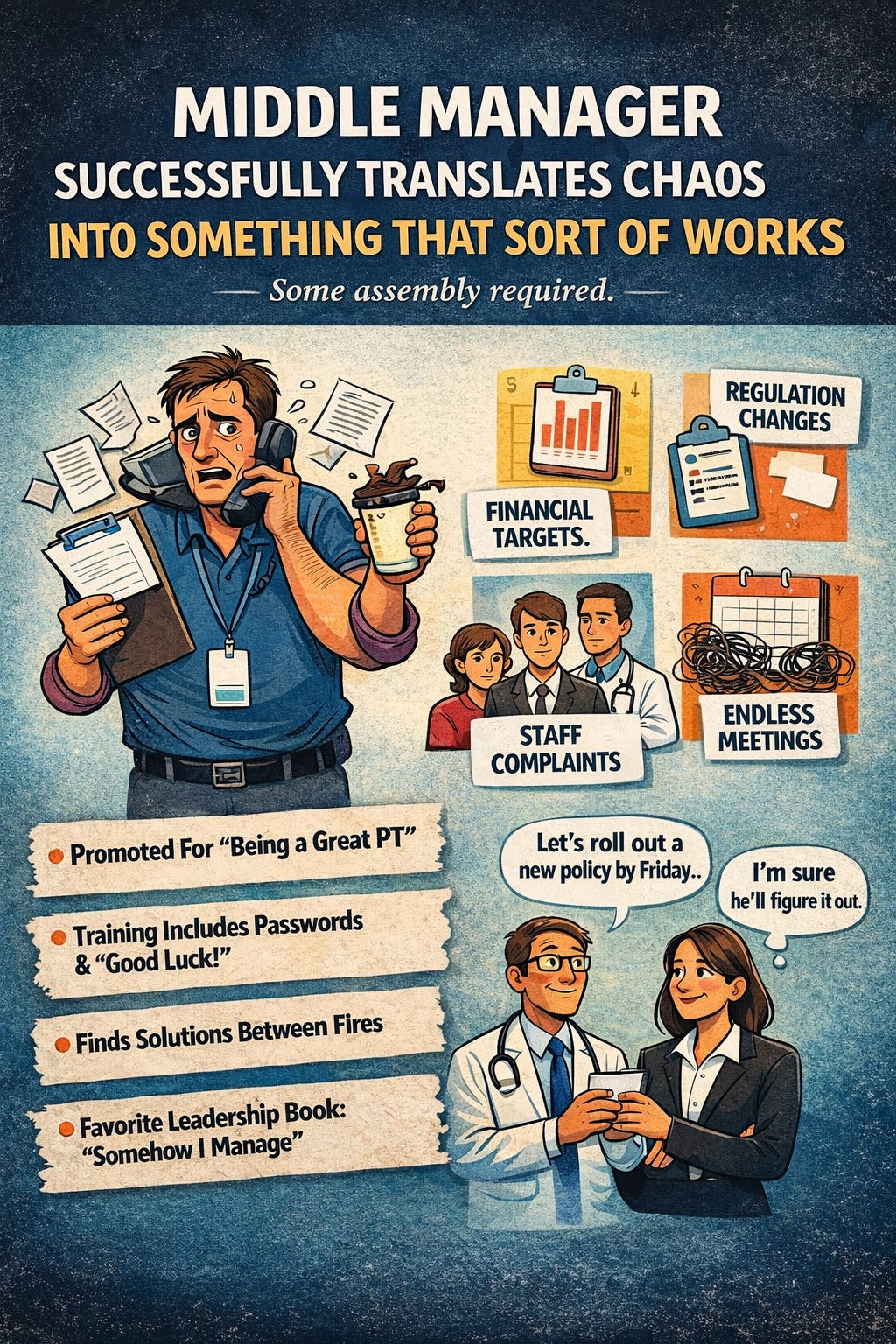
In healthcare, we spend an enormous amount of time debating strategy at the top and performance at the front line.
Executives talk about margin compression, reimbursement cuts, value-based care, and growth. Clinicians talk about burnout, productivity expectations, documentation, and patient care.
But there’s a critical layer in between that determines whether any of this actually works.
Middle managers.
I’m talking about roles like physical therapy directors. Rehab managers. Nurse managers. Clinical supervisors. Operations leads.
These roles are often treated as administrative overhead but, in reality, they are one of the most important, and most fragile, components of the healthcare system.
If you want financial stability, operational reliability, and sustainable patient care, your middle managers are not optional. They are the operating system.
Middle Managers Are Where Strategy Either Becomes Reality or Dies
Healthcare organizations love strategic plans.
Five year growth projections. Access initiatives. Quality dashboards. New service lines. “Transformational initiatives”. These buzz words really get the McKinsey consultants fired up.
But none of these things happen because they were written in a boardroom or discussed in a meeting.
They happen, or they fail, in the daily decisions made by middle managers:
How schedules are built
How staffing shortages are handled
How policies are interpreted in real time
How productivity targets are enforced (or ignored)
How frontline concerns are translated upward
Executives design the intent and frontline staff execute tasks.
But middle managers translate intent into behavior.
When that translation fails, organizations blame the “culture”, “resistance to change”, “staff burnout”, “shortages”.
Often, the real issue is that the middle layer was never equipped to do its job.
Financial Performance Is Won or Lost in the Middle
Let me be blunt… healthcare margins don’t erode at the executive level. They erode operationally.
Middle managers directly influence things like utilization, no-show rates, visit volume, overtime usage, staffing ratios, supply costs, documentation quality (and therefore billing integrity).
A manager or director who understands demand patterns, lead time, capacity constraints, variability (both predictable and unpredictable), and incentive alignment, can protect hundreds of thousands, or even millions of dollars annually.
Conversely, an undertrained manager can quietly bleed revenue while “meeting productivity” on paper.
Finance doesn’t fail loudly in healthcare. It fails through thousands of small, unmanaged operational decisions.
Those decisions live in the middle.
Middle Managers Are the Shock Absorbers of the System
Healthcare systems are under constant stress between reimbursement cuts, regulatory pressure, staffing shortages, patient expectations, tech developments, competing organizational priorities,…etc.
Middle managers absorb that pressure from both directions.
From above…. “more access”, “better metrics”, “we need this rolled out by next quarter”
From below…. “we’re short staffed”, “this workflow doesn’t make sense”, “morale is low”
They are expected to enforce standards, maintain morale, deliver results, stay compliant, be empathetic, be decisive
Often without authority, training, or real support.
When middle managers fail, organizations interpret it as a “people problem”.
But this is not accurate.
Why Healthcare Struggles to Develop Middle Managers
Most middle managers in healthcare were promoted because they were either strong clinicians, reliable employees, or high performers.
Not because they were trained operators.
They’re then expected to suddenly master areas like budgeting, staffing models, conflict resolution, data interpretation, regulatory risk, and cross-departmental influence.
This results often times in reactive leadership, inconsistent enforcement, burnout, quiet disengagement, and holding patterns instead of improvement.
Healthcare doesn’t lack talent. But it does often lack intentional manager development.
The Organizations That Win Invest in the Middle
High-performing healthcare organizations understand something critical:
You scale care by stabilizing the middle.
They invest in operations training (not just compliance), decision-making frameworks, communication skills across levels, data literacy, and accountability systems that support (instead of punish).
They treat middle managers as operators, translators, risk managers, and culture carriers, rather than glorified schedulers or administrative buffers.
And they get predictable results… better access, more stable finances, less chaos, higher staff retention, and fewer “fire drills”.
Final Thought: Middle Managers are the Leverage Point
Healthcare loves to talk about fixing the system.
But systems don’t change at the extremes. They change at the connection points.
Middle managers are where clinical care, operations, finance, and strategy intersect.
Ignore them, and no amount of vision will save you.
Develop them, and even imperfect systems can perform pretty well.
If healthcare wants sustainability, not just survival, it’s time to pay attention to this vital connection in the system. They aren’t the middle of the organization. They are the system.